

DO YOU EAT ENOUGH ‘ROUGHAGE’?

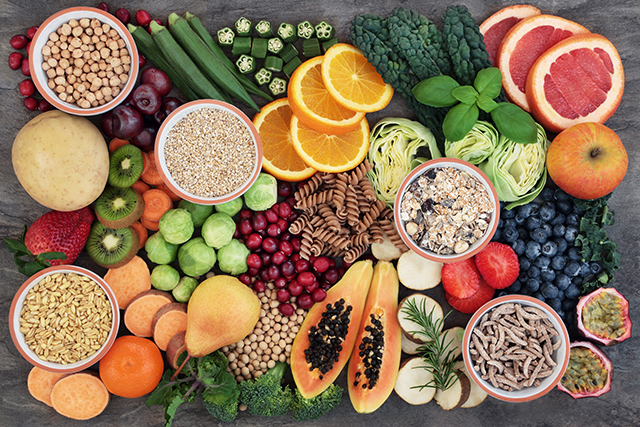
Around 50 years ago, fibre in the diet was regarded as something called ‘roughage’ and regarded as a waste product. In some Middle Eastern countries, unleavened wholewheat breads had been associated with mineral deficiencies and infertility (1). In animal diets, too much fibre had been shown to slow the rate of growth and muscle deposition. Roughage was cheap to feed so farmers were keen to use as much as they could get away with.
In the 1980s, two medical doctors by the name of Dennis Burkitt and Hugh Trowell from St Thomas Hospital London, rocked the boat by arguing that there was too little in human diets and this was causing harm, including constipation and colon cancer (2).
Fast forward to today, where we have a generation of young people, more males than females, who are being diagnosed with colorectal cancer (3). If too little fibre is part of the reason (there may be many factors), we need to act.
How much fibre do authorities recommend?
Most dietary guidelines suggest 25-30 g per day which is not a lot. In 2023, Australians were getting about 21 g (down from ~23 g in 2011-12) and Americans were consuming 10-15 g on average. Contemporary hunter-gatherers often get 75 g a day. To be honest, I think that’s closer to the mark.
What is fibre?
Technically speaking, fibre is made up of ‘unavailable carbohydrates’ – carbohydrates that are indigestible and/or unabsorbable in the small intestine, reaching the large bowel intact. Once there, many forms of fibre are fermented by the resident microbial flora (“microbiome”) to short chain fatty acids and gases such as hydrogen and methane. These gases are responsible for flatulence, but ‘gas’ is perfectly normal, unless it’s painful.
The products of microbial fermentation – short chain fatty acids, including acetic acid, also found in vinegar – are absorbed into the blood stream and metabolised in the liver. Some of them improve insulin sensitivity, a good thing that helps lower blood glucose levels and prevent the development of type 2 diabetes.
Another type of short chain fatty acid – butyric acid – is used directly as their source of fuel by the endothelial cells lining the large bowel. It make sense to feed them! In fact, butyric acid also inhibits differentiation of these cells into polyps and cancerous lesions.
Why is fibre healthy?
We hear a lot about the microbiome these days; we can even assess exactly which organisms are there and in what proportions using whizz-bang DNA sequencing. While we know which ones are pathogenic, producing symptoms like diarrhea, we are not sure which ones are the most beneficial.
In a breast-fed baby, there are many species of Lactobacilli and Bifidobacteria, that ferment lactose to lactic acid which lowers the pH of their stools and inhibits pathogens. All good for the baby – and maybe they are beneficial for adults too? The popular probiotic product called Yakult is rich in Lactobacillus casei strain Shirota.
When small chain indigestible carbohydrates called oligosaccharides reach the large bowel, they tend to be fermented rapidly, producing gases that lead to uncomfortable distension. They are commonly found in beans and legumes, but consistent intake helps the bowel flora adapt and reduces flatulence in the longer term.
Observational studies have indicated that high fibre intake, mostly from cereals, is associated with lower risk of developing cardiovascular disease, type 2 diabetes and cancer. Low cereal fibre intake is linked to colorectal cancer, but we don’t know if that’s cause-or-effect. It’s been hard to prove that adding isolated fibres (i.e., supplements) improves risk factors. Other considerations are fatty meats, preserved meats, alcohol and the forever chemicals like PFAS (per- and polyfluoroalkyl substances).
We hear a lot of debate about low carbohydrate diets, especially for management of type 2 diabetes. But can fibre intake be adequate if we follow a low carb diet? It’s certainly more difficult because foods high in fibre tend to be high in available carbs too – think whole grains and fruit. But there are vegetables that have a high fibre content without being high in available carbs – most salad vegetables, cabbage and broccoli, for example. Admittedly, you have to eat a lot of them. In Australia, total available carbohydrate consumption has been decreasing over the past few decades and perhaps unsurprisingly, so has fibre intake.
One reason that whole grain foods are associated with good health today is not because of fibre per se but because they are richer in micronutrients – these lie in highest concentration directly underneath the fibrous layer of the seed. Another possibility is that some types of fibre reduce the rate of digestion of starch and sugars – these are viscous gums like guar, psyllium and pectin. They lower the glycemic index too.
This brings me to a novel metric – it’s called the carbohydrate quality index or CQI. It was devised by Spanish researchers led by my colleague J. Alfredo Martinez at the University of Navarra in Pamplona. It’s based on four criteria: the ratio of wholegrains to total grains, the ratio of solid carbohydrate to liquid carbohydrate, the glycemic index and the fibre content.
In a cohort of almost 17,000 healthy individuals participating in the SUN Project, the highest CQI was linked to the highest intake of all micronutrients (4). In a sample of 277 women in Ghana, those with the highest CQI had a 75% reduced risk of having obesity (5). And in a case-control study in Iran, patients with the highest CQI had 76% lower odds of a diagnosis of colorectal cancer (6).
I hope we’ll see more research using this all-rounded index of carbohydrate quality where fibre is just one component.
Read more:
- Lorenz and colleagues. The nutritional and physiological impact of cereal products in human nutrition. C R C Critical Reviews in Food Science and Nutrition, 1977.
- Trowell and Burkitt. Diseases of modern civilisation. Br Med J, 1981.
- Vuik and colleagues. Increasing incidence of colorectal cancer in young adults in Europe over the last 25 years. Gut, 2019.
- Zazpe and colleagues. Association between dietary carbohydrate intake quality and micronutrient intake adequacy in a Mediterranean cohort: the SUN (Seguimiento Universidad de Navarra) Project. Br J Nutr, 2014.
- Suara and colleagues. Association between Carbohydrate Quality Index and general and abdominal obesity in women: a cross-sectional study from Ghana. BMJ Open, 2019.
- Kahrizsangi and colleagues. Carbohydrate quality indices and colorectal cancer risk: a case-control study. BMC Cancer, 2023.
Emeritus professor Jennie Brand-Miller held a Personal Chair in Human Nutrition in the Charles Perkins Centre and the School of Life and Environmental Sciences, at the University of Sydney until she retired in December 2022. She is recognised around the world for her work on carbohydrates and the glycemic index (or GI) of foods, with over 300 scientific publications. Her books about the glycemic index have been bestsellers and made the GI a household word.

Latest Blog Post List